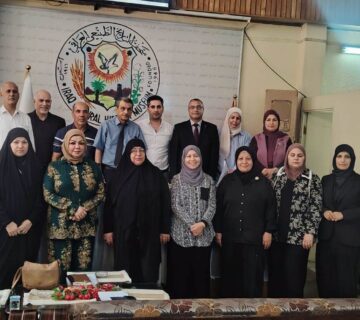
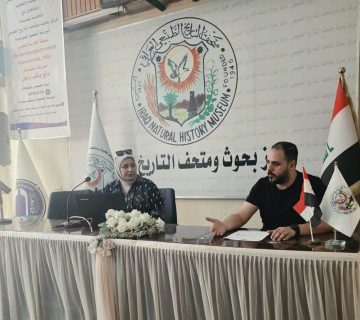
The Natural History Research and Museum Center at the University of Baghdad, with the support and guidance of Assistant Professor Dr. Hanaa Hani Al-Saffar, the center’s director, organized a workshop entitled “Mammals as Biological Indicators of Climate Change in Iraq” on Sunday, January 18, 2026. The workshop was moderated by Chief Agricultural Engineer Inas Abdul Khalifa and presented by Professor Dr. Afkar Muslim Hadi and Assistant Lecturer Yasmin Sarmad Hassan.
Climate change represents long-term shifts in temperature, precipitation patterns, and climatic fluctuations that extend over decades or centuries. These shifts directly affect ecosystems and biodiversity globally by altering species distribution, physiological functions, and survival patterns. Mammals, like all living organisms, are sensitive to climatic conditions, making them valuable biological indicators, as their presence or absence, behavior, and physiological state reflect underlying environmental changes. A biological indicator is a single species or group of species whose condition provides information about the health of an ecosystem or about changes in environmental conditions. Biological indicators not only reflect responses to pollution but also changes in temperature, water availability, habitat change, seasonal (phenological) shifts, and general environmental stressors.
The workshop aimed to demonstrate that mammals are effective biological indicators of climate change, reflecting its impacts across physiological, behavioral, and demographic levels. Studying mammals in Iraq contributes to:
• Enhancing the understanding of the impact of climate change on ecosystems.
• Providing early warning indicators of environmental stress.
• Supporting conservation and adaptation strategies to climate change.
As temperatures continue to rise and drought intensifies in Iraq, monitoring mammals and their responses becomes crucial for understanding ecosystem resilience and adaptive capacity.
In conclusion, the researchers recommended that to utilize mammals as biological indicators in Iraq, researchers could:
1. Monitor population trends of vulnerable species (such as small rodents, bats, and foxes). 2. Track changes in geographic range and habitats and correlate them with climate data.
3. Monitor indicators of physiological stress, such as body condition and reproductive success.
4. Integrate mammal data with vegetation indicators and climate data to obtain a comprehensive analysis.
5. This approach contributes to providing early warning of environmental degradation before it reaches irreversible stages.
6. Despite the abundance of global studies on mammals and climate change, specialized regional studies in Iraq remain limited, particularly those focusing on local wildlife species. This gap represents a significant research opportunity for future studies.

اخبار ذات صلة



Comments are disabled.