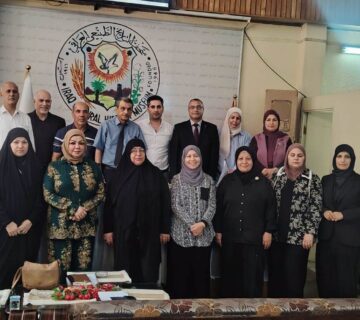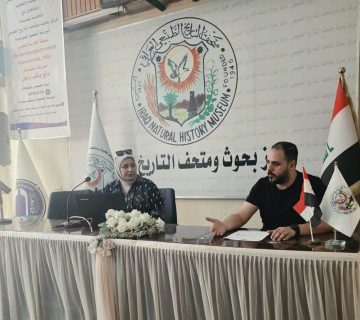

The Natural History Research and Museum Center at the University of Baghdad, with the support and guidance of Assistant Professor Dr. Hanaa Hani Al-Saffar, the center’s director, organized a workshop entitled “Nature’s Trap: Poisonous Mushrooms Resembling Edible Ones” on Sunday, January 18, 2026. The workshop was led by Chief Agricultural Engineer Inas Abdul Khalifa and presented by Assistant Professor Dr. Khansaa Rashid , Assistant Lecturer Sarah Jamal Jalil, and Assistant Lecturer Zainab Ghazi Sadiq.
The Iraqi environment, especially during the rainy seasons (autumn, winter, and spring), is fertile ground for the growth of various types of fungi, particularly in the northern regions (Kurdistan) and the riverbanks and farms of central and southern Iraq. Many people fall into the trap of mistaking the wild “white mushroom” and the “Aconidarium” for highly poisonous species. The workshop aimed to:
1- Clarify the morphological confusion between similar fungal genera.
2- Highlight the fungal diversity in Iraq and the risks of local toxicity. 3- Providing recommendations to enhance laboratory testing versus traditional field experience.
The workshop concluded with a set of findings:
1- Phenotypic Dependence: The main conclusion is that external morphological characteristics (color, shape, odor) are absolutely insufficient to determine the toxicity of a mushroom, given the existence of “sister species” that are morphologically identical but genetically and toxicologically different.
2- Environmental Deception in Iraq: The Iraqi environment (especially after rainy and thundery seasons) accelerates the growth of *Argon* and *Gambinon* fungi. These are environments where the virulent and toxic species mix due to pollution or genetic similarity.
3- Microscopic Differences Are the Decisive Factor: The study proved that microscopic examination of spores and chemical analysis of the reaction (such as the KOH test) are the two most accurate methods before genetic classification. 4. Cumulative Toxicity: Some fungi in Iraq may not be “mycologically” toxic, but they act as “biological accumulators” of pollutants and heavy metals present in the local soil, making them an indirect health hazard.