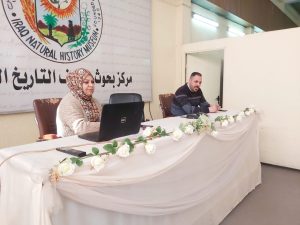
The Natural History Research and Museum Center, continuing its program of scientific activities under the support and guidance of its administration, recently hosted a discussion session on “Human Lice and Their Medical Importance.” Organized by the Center’s Workshops and Seminars Committee, the session featured Assistant Lecturer Ali Kamel Wanas as moderator and presentations by Assistant Prof. Dr. Hana Hani Al-Saffar and Lecturer Dr. Suhad Yassin Jassim.
Dr. Al-Saffar and Dr. Jassim highlighted the widespread occurrence of head lice infestation, a condition with a history stretching back to ancient times, with current estimates ranging from 6 to 12 million cases annually. They further explained the existence of three distinct types of lice, each specific to different areas of the body, categorized by infestation site as:
Head lice (Pediculus humanus capitis)
Body lice (Pediculus humanus corporis)
Pubic lice (Pediculus pubis)
The discussion aimed to elucidate the transmission pathways of lice infestation, which include:
Direct contact, such as through the sharing of personal items like hair combs.
Contact with fabrics harboring the lice, which can survive on these materials for up to a week.
Contact with bedding and furniture contaminated with lice, particularly in transient environments like hotels, where lice can live for 1 to 2 days away from a host.
The researchers emphasized the necessity of implementing a thorough program to eradicate lice. This includes personal cleaning, treating affected children, and decontaminating potentially infested personal belongings. They also recommended that individuals with lice check other family members for infestation signs and treat anyone showing evidence of lice with appropriate topical creams and shampoos.
The Center extends its best wishes to its faculty members for their ongoing success in serving the community and advancing knowledge and science.


