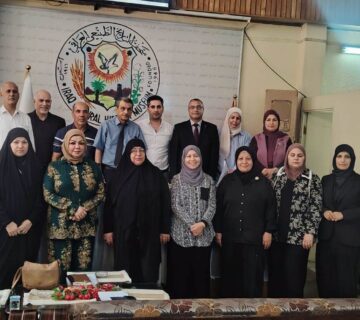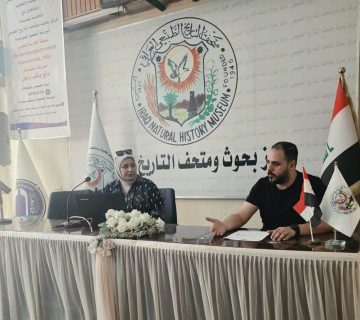

Continuing its series of scientific activities, and with the support of its administration and Assistant Professor Dr. Hana Hani Al-Saffar, the Workshops and Seminars Committee of our center recently organized a workshop on “Using Fungi as a Bioindicator of Pollution.” Held on Wednesday, April 30, 2025, the workshop was moderated by Assistant Lecturer Ali Kamel Wannas and co-presented by Assistant Lecturer Lubna Majeed Hamid, a lecturer in the Department of Botany and Environment.
The workshop explored the biological treatment of water as a modern and effective approach to pollutant removal using microorganisms. Among these, fungi are recognized as a significant tool due to their exceptional capacity to degrade and neutralize toxic substances and pollutants. Their environmental adaptability and ability to decompose complex organic compounds, which can be detrimental to the environment and human health, make fungi valuable in water bioremediation processes.
The workshop aimed to investigate the potential of fungi in natural water purification processes, recognizing that water, a vital element for life, is susceptible to pollution from various human activities, including agricultural industries, improper waste disposal, and industrial pollution.
The researcher recommended the implementation of scientific research focused on utilizing fungi for the treatment of water pollution involving heavy metals such as lead and mercury, given their demonstrated high efficiency in breaking down these elements.
We wish all our center’s educators success in their ongoing efforts to serve the community, advance science, and enrich knowledge.