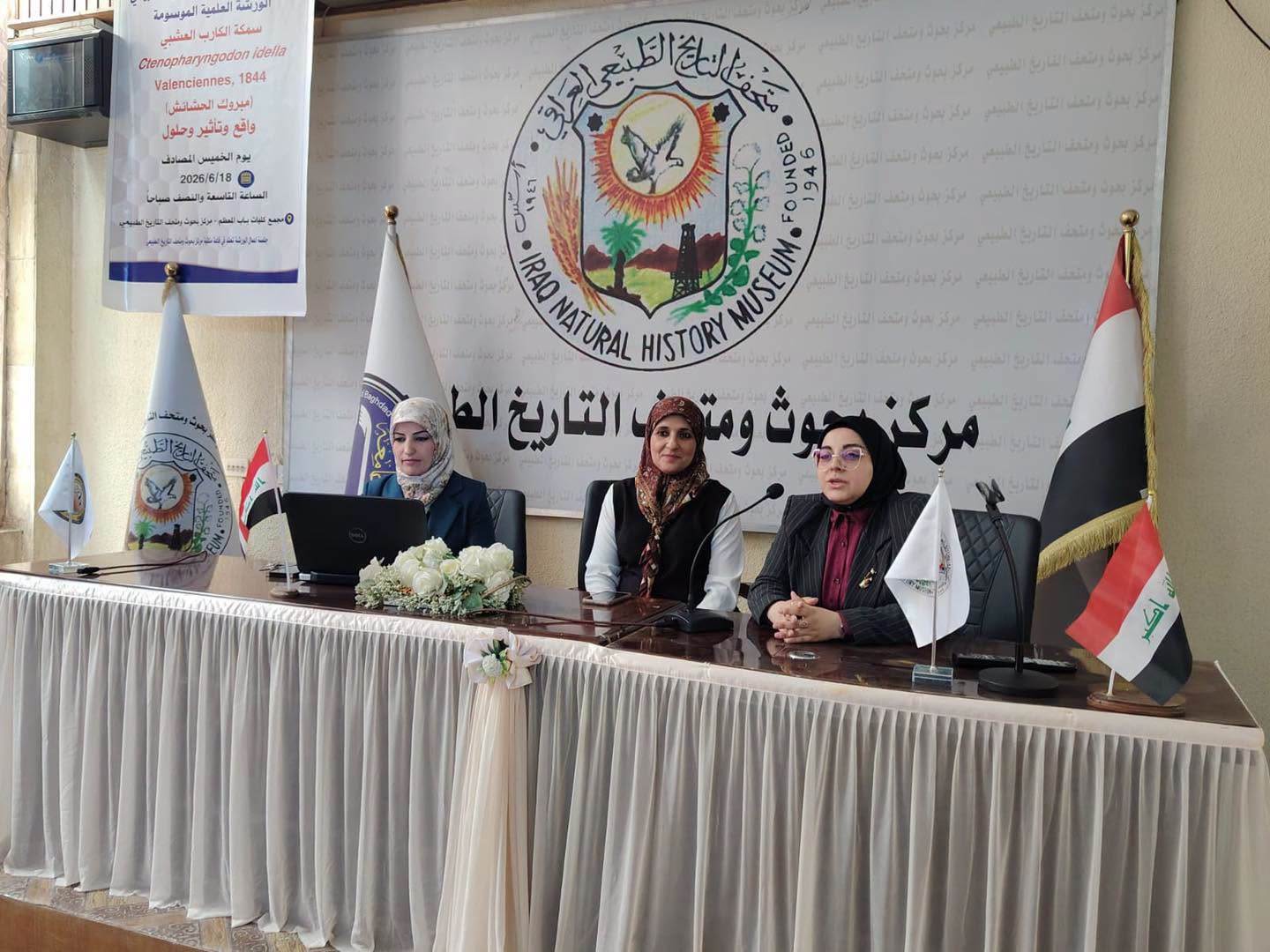
The Natural History Research Center and Museum / University of Baghdad, with the support and guidance of the Center’s Director, Professor Dr. Hana Hani Al-Saffar, organized a workshop entitled “Women and Environmental Leadership in the Workplace” today, Monday, October 4, 2026, which was held by the Center’s Women’s Affairs Committee. The workshop was managed by Assistant Lecturer Yasmine Sarmad Hassan and delivered by Assistant Professor Dr. Zainab Alwan Makkawi and Assistant Lecturer Khalida Ibrahim Hassoun.
The workshop addressed the concept of environmental leadership and its importance in the work environment, as the ability of an individual or organization to direct decisions and practices towards protecting the environment, increasing the efficiency of using resources, and reducing environmental impact, in addition to the importance of making sustainable decisions, employee participation, and monitoring and measuring results.
The workshop touched on the possibilities of applying environmental leadership in academic institutions, including rationalizing energy and water consumption, proper waste management, preserving green spaces and biodiversity, reducing unnecessary use of paper, supporting research related to sustainability, and spreading environmental culture among students and workers.
The workshop aimed to improve the effectiveness of environmental leadership, the most prominent of which are limited resources and capabilities, weak institutional environmental awareness, resistance to change, the absence of clear environmental plans, limited specialized training, weak coordination between units and departments, as well as the difficulty of measuring the environmental impact of some initiatives.
At the conclusion of the workshop, the participants recommended the necessity of integrating environmental leadership into the strategic plans of institutions and adopting it as part of the culture of institutional work, supporting the participation of women in environmental committees and projects and decision-making positions according to competence and experience, in addition to organizing continuous training programs to develop women’s skills in leadership, sustainability, and environmental management. They also stressed the importance of encouraging applied research that contributes to finding solutions to local environmental problems and, finally, adopting clear indicators to measure the performance and environmental impact of institutions and following up on the results of environmental initiatives.
This activity achieves the fourth goal (quality education), the fifth goal (gender equality), and the seventeenth goal (partnerships to achieve the goals) of the Sustainable Development Goals.
اخبار ذات صلة


Comments are disabled.